When spreadsheets become operational glue
Spreadsheets are incredible tools. Nearly every successful business uses them in some capacity.
The issue isn't spreadsheets themselves; it's what happens when your team starts using them to bridge the gaps between multiple software systems.
If your business depends on copying information between different tools, manually building reports every week, or maintaining several versions of the same data, it may be time to rethink the way your operations work.
The real problem is not that spreadsheets exist. It is that your best people may be spending their time moving information instead of making decisions, serving customers, or improving the business.
1. You're entering the same information more than once
Duplicate work usually starts quietly. A customer registers in one system, someone copies the details into a spreadsheet, another person updates accounting, and someone else sends an email or calendar invite.
Each step feels small by itself. Together, they create a process where the same information has to be typed, checked, and fixed in multiple places. That is time your team never gets back.
2. Nobody knows which spreadsheet is correct
If your team has files named Version Final, Version Final FINAL, Version New, or anything similar, the spreadsheet has stopped being a shared source of truth.
Conflicting numbers create slow decisions. People spend time asking which file is current, why totals do not match, and who made the last edit. The work becomes less about running the business and more about reconciling the spreadsheet.
3. Your best employees spend their time moving information instead of making decisions
Manual reporting is one of the clearest signs that workflows are becoming expensive. If someone spends just 90 minutes every Friday building reports, that is nearly 80 hours every year spent moving data around.
Downloading CSVs, cleaning columns, pasting data, and rebuilding charts every week may be familiar, but it should not be the long-term operating system for a growing business. Reports that matter every week should be available without asking a person to rebuild the same thing over and over.
4. One employee understands everything
Many businesses have one person everyone asks when something needs to be updated, fixed, exported, reconciled, or explained. That person knows which spreadsheet matters, which formulas are fragile, and which steps are undocumented.
The risk shows up when that person goes on vacation, gets sick, or simply becomes too busy. When operational knowledge is trapped in one person, the business is relying on memory instead of a system. That is the bus factor problem in plain business terms.
5. You're paying for great software that doesn't work together
QuickBooks, Google Drive, Stripe, Google Forms, PlayMetrics, scheduling software, and email can all be excellent tools. The problem usually is not that the software is bad.
The problem is the lack of integration. When your best systems do not share the right information at the right time, your team becomes the integration layer. That is where duplicate work, missed updates, and scattered reporting come from.
Before and after
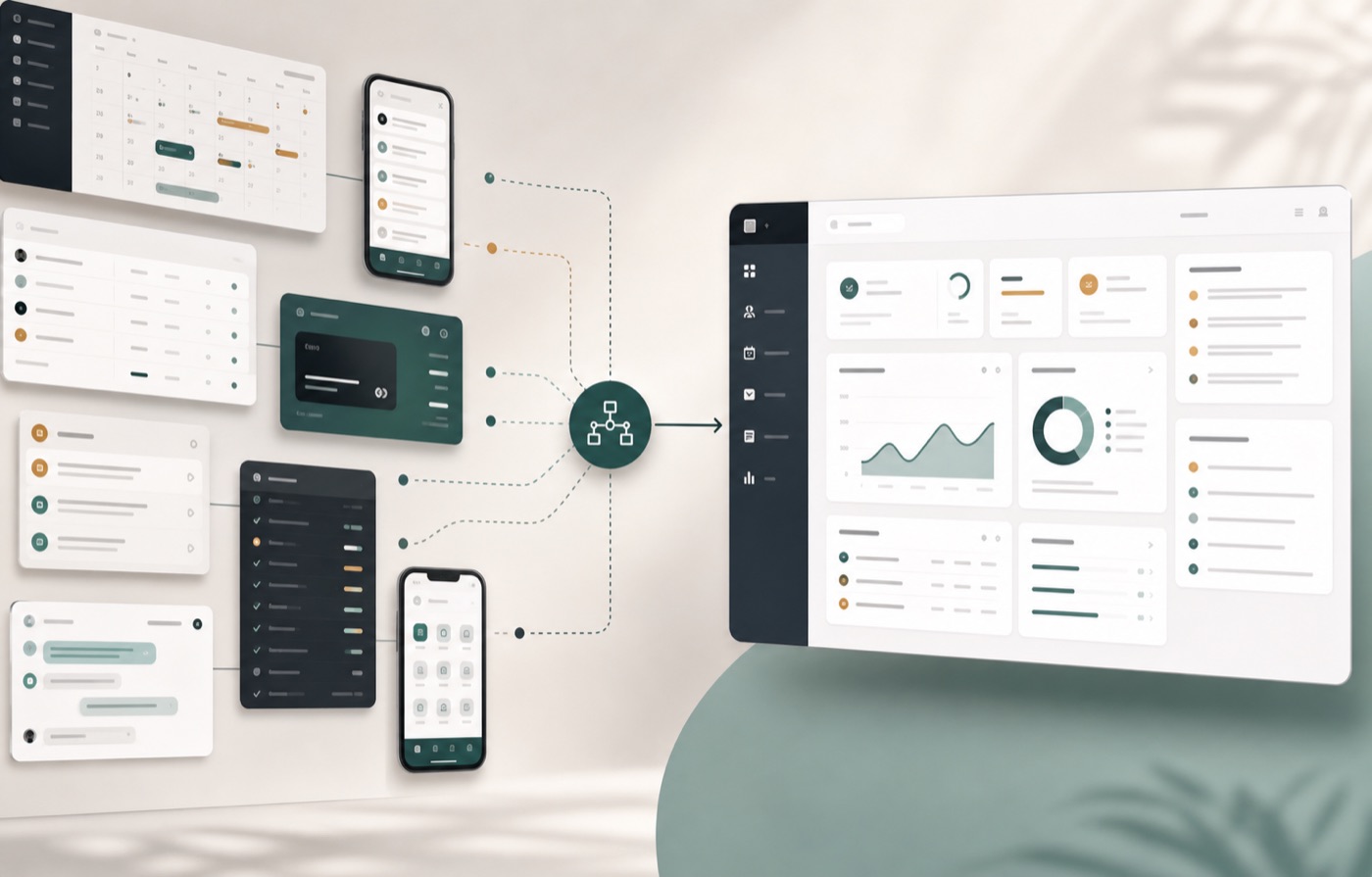
One lightweight dashboard replaces dozens of manual steps.
Before
After
Free open source starter
Free Open Source Starter
Want to build an internal business tool yourself? I've open sourced the same React starter I use to build internal dashboards and operational tools for businesses.
This isn't a demo project; it's the same foundation I use when building custom internal tools for clients.
It includes authentication, dashboards, reusable components, tables, charts, and is ready to deploy. Perfect if you're technical or want to experiment with AI-assisted development.
Even if you're not a developer, this project is designed to work well with AI tools like ChatGPT or Codex. Many business owners are surprised how far they can get by describing the dashboard they want.
Free assessment
Want to find your biggest time sink?
I offer a free 30-minute Systems & Workflow Assessment. We'll walk through one of your operational workflows and I'll send you a one-page report outlining:
- Bottlenecks
- Opportunities for automation
- Potential software ideas
- Estimated time savings
No obligation.
Get My Free Workflow Assessment